
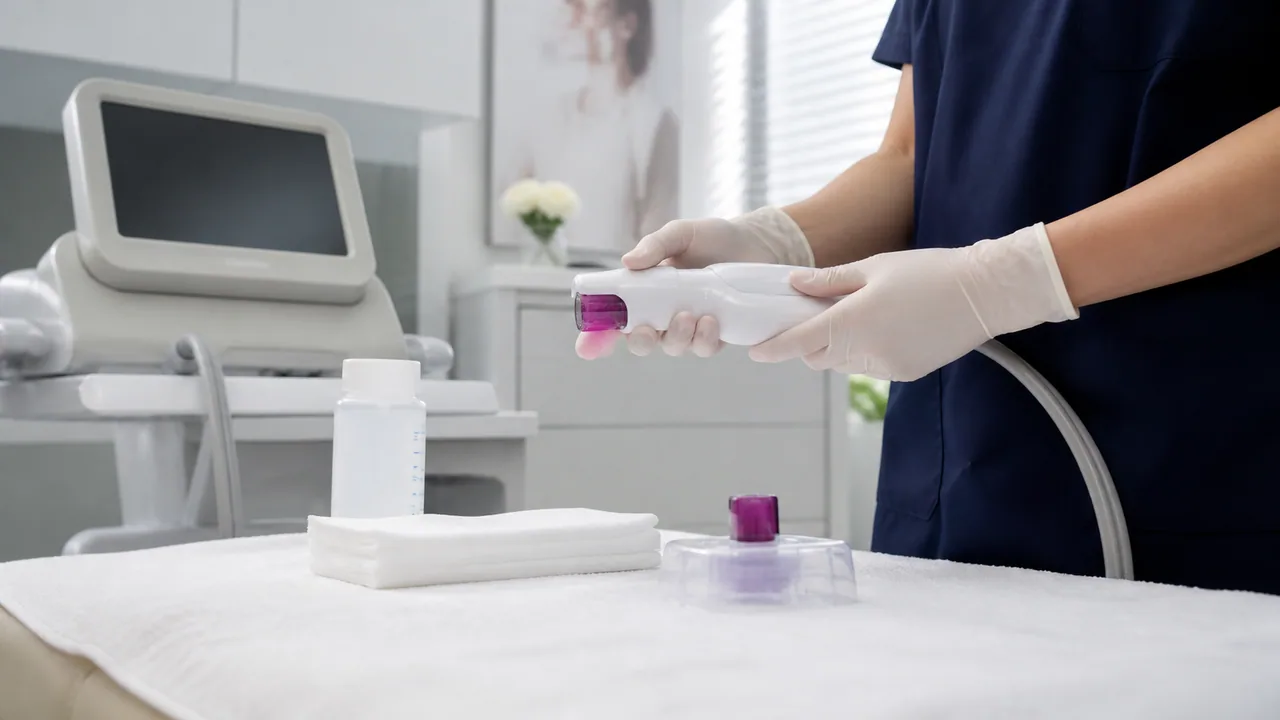
Is Thermage a proven substitute for a facelift?
Thermage is a branded monopolar radiofrequency system; studies suggest selected patients may see modest skin-tightening changes, but outcomes and protocols vary and it is not a substitute for surgical correction of substantial laxity.
Brand-specific evidence should stay attached to the Thermage system and model studied. Generic radiofrequency devices cannot inherit the brand’s studies, and a Thermage logo does not independently verify the supplied device or consumable. AestheticClinic.my is an independent Malaysian publisher, not a clinic, so this page explains evidence and verification rather than recommending a provider.
Key takeaways
| Question | Answer |
|---|---|
| What is it? | Thermage uses a named monopolar radiofrequency platform and treatment tips to deliver controlled heating while cooling the skin surface. It belongs within a broader radiofrequency category but has device-specific protocols and records. |
| Who may benefit? | An adult with mild laxity and a modest, measurable goal. |
| What does evidence show? | A systematic review of monopolar and bipolar RF reports improvement signals across aesthetic outcomes but substantial variation in devices, methods and outcome measurement. |
| What is the main limitation? | Magnitude and durability vary. |
| What should Malaysians verify? | The exact procedure, registered practitioner and relevant LCP scope, registered premises, and product or device where applicable. |
What is Thermage and how is it different from generic RF?
Plain-language definition
Thermage uses a named monopolar radiofrequency platform and treatment tips to deliver controlled heating while cooling the skin surface. It belongs within a broader radiofrequency category but has device-specific protocols and records.
Models, tips, treatment areas and energy-delivery protocols vary. Evidence for facial laxity should not be copied to body areas, eye protocols or unrelated RF equipment without qualification.
The words used in advertising can compress several different entities into one label. For Thermage Malaysia, readers should separate the concern being assessed, the generic procedure or category, any named product or device, and the outcome actually measured. That distinction prevents evidence for one protocol from being presented as proof for every service using a similar name.

Why does assessment matter before choosing an option?
Assessment should record laxity severity, anatomy, sensation, implants or metal, prior procedures, skin disease, medicines, tolerance for pain and uncertainty, and whether the intended change is realistic for a non-surgical device.
A useful assessment records the reader’s main concern, timeline, severity or pattern, previous treatment, current medicines, relevant medical history, skin or tissue characteristics, and tolerance for downtime and uncertainty. These factors can change whether Thermage Malaysia is reasonable, whether a different option deserves priority, or whether treatment should be deferred.
Assessment also tests the goal. A request for complete, permanent or surgery-equivalent change may not match the evidence. The clinician should translate the goal into an observable outcome, explain how it will be documented, and discuss the option of no procedure alongside active alternatives.

What does current evidence show—and what remains uncertain?
A systematic review of monopolar and bipolar RF reports improvement signals across aesthetic outcomes but substantial variation in devices, methods and outcome measurement. a systematic review of monopolar and bipolar RF.
Many studies are small, uncontrolled or device-specific; an average score cannot guarantee a visible result, duration or one-session response for an individual. Malaysia's aesthetic medical practice guideline.
Published averages do not predict an individual result. Study participants, devices or products, technique, treatment area, outcome scale and follow-up may differ from the proposed Malaysian service. Any estimate should therefore stay linked to the exact evidence base and be presented with the uncertainty that accompanies it. the official Malaysian 3P verification route.
Who might discuss branded monopolar RF?
- An adult with mild laxity and a modest, measurable goal.
- Someone seeking a non-surgical option and accepting variable response.
- A person whose implants, sensation and medical history have been assessed.
- Someone who can verify the exact platform, treatment tip, practitioner and premises.
Who may need a different or more urgent assessment?
- Substantial laxity with surgery-equivalent expectations.
- Active infection, impaired sensation or an unassessed implant/electronic device.
- Inability to report excessive heat or pain during treatment.
- A clinic unable to identify the exact device, tip and Malaysian registration.
What should happen from consultation to follow-up?
-
1. Define the concern and intended outcome
The consultation should identify what the reader wants to change, distinguish relevant patterns or diagnoses, document a baseline and agree on a realistic outcome. A marketing label is not a clinical assessment, and a package should not be selected before this step.
-
2. Verify the exact option
Record the generic procedure, named product or device, treatment area, parameters or dose basis, who will perform it and where. Check the practitioner’s registered identity and relevant LCP scope, the premises, and the product or device through the applicable official Malaysian source.
-
3. Discuss evidence, alternatives and consent
The consent discussion should place potential benefit beside important limitations, common adverse effects, uncommon serious complications, alternatives, expected recovery and the plan if the response is poor or a complication occurs. Questions should be answered before payment pressure or treatment.
-
4. Document treatment and reassess
If treatment proceeds, retain the date, exact item or technique, relevant parameters, batch where applicable, treatment area, aftercare and follow-up route. Reassessment should use comparable photographs or measures and should change or stop the plan when benefit, tolerability or safety does not justify continuing.
What are the potential benefits?
- Non-incisional treatment with limited surface wound care for many protocols.
- A named platform permits device-specific verification.
- May support modest tightening outcomes in selected people.
- Usually allows structured photographic follow-up without a surgical recovery course.
What are the main limitations?
- Magnitude and durability vary.
- Pain and heat tolerance can limit treatment.
- Brand evidence does not transfer to generic RF.
- A higher price does not prove an authentic device or better outcome.

How does this compare with relevant alternatives?
| Option | May be discussed for | Important trade-off |
|---|---|---|
| Generic RF tightening | When an independently verified device has relevant evidence. | Different platforms and protocols are not interchangeable. |
| Focused ultrasound | Selected laxity with a verified device and depth plan. | Different energy, sensation, evidence and risk profile. |
| Surgical lifting | More substantial structural laxity. | More invasive with longer recovery and surgical risks. |
No comparison table can choose an option for an individual. The useful question is whether the alternative targets the same problem with a better balance of evidence, expected magnitude, reversibility, downtime, cost basis and risk for that person.

What safety issues, contraindications or warning signs matter?
Pain, warmth, redness and swelling may occur. Excessive heat or pain during delivery should not be dismissed because settings and contact affect thermal injury risk.
Burns, blistering, altered sensation, contour change, fat injury or scarring are uncommon but important possibilities requiring a clear escalation plan.
Implants, electronic devices and altered sensation require product-specific screening; online lists cannot replace the manufacturer’s current instructions and medical assessment.
Consumable authenticity, single-use status where applicable and treatment records should be documented rather than inferred from branding.
What follow-up is appropriate after Thermage?
Record the exact platform, serial or registration evidence, treatment tip, area, parameters and date.
Use consistent photographs and a defined follow-up interval; immediate swelling should not be presented as durable tightening.
Seek assessment for blistering, severe or increasing pain, persistent numbness, skin colour change or contour depression.
Malaysia Price Atlas
Want to compare current advertised prices?
The separate 2026 study publishes source-attributed Malaysian figures while keeping different products, devices, areas, units, sessions and package conditions distinct. It does not turn unlike offers into a false national average.
How should Malaysians verify the procedure, practitioner and premises?
Use the Ministry of Health Malaysia’s three-part sequence: verify the exact procedure, the registered practitioner and relevant LCP scope, and the registered premises. Where a medicinal product or medical device is involved, check the exact item through the appropriate NPRA or MDA source rather than relying on a brand logo or clinic screenshot.
Keep a dated record of the exact name, branch, product or device, quoted basis, consent discussion and aftercare route. An official registration check confirms only the field checked on that date; it does not guarantee individual suitability, clinical quality or outcome.
How can you test whether a proposed plan is specific enough?
A defensible plan for Thermage Malaysia should be detailed enough for another qualified practitioner to understand what is being proposed and why. It should name the assessed concern, intended outcome, exact product, device or technique where relevant, treatment area, session or dose basis, alternatives, material risks, expected recovery, review point and the route for urgent help. Phrases such as “premium,” “medical grade,” “FDA approved,” “Korean technology” or “doctor designed” do not replace those facts.
Ask the practitioner to separate what is established, what is a reasonable clinical inference and what remains uncertain. If evidence comes from a different device, product, body area, population or protocol, that difference should be stated. Testimonials, immediate post-treatment photographs and mechanism diagrams can generate a hypothesis, but they cannot prove durable benefit or predict an individual result.
What should appear in the written consent and treatment record?
- The diagnosis or working assessment, baseline photographs or measures, and the specific outcome being pursued.
- The generic procedure plus exact brand, model, formulation, batch, parameters, dose or treatment area wherever applicable.
- Common effects, important uncommon harms, personal risk modifiers, alternatives—including no treatment—and realistic recovery.
- The practitioner, premises, price basis, included follow-up, cancellation terms and who will assess an unexpected reaction.
- A review point with stop, change or referral criteria rather than an automatic commitment to every session in a package.
How should results and value be judged?
Compare outcomes only after the expected short-term swelling, redness or other recovery has settled. Use the same lighting, angle, distance, expression and timing for photographs, or a relevant validated scale when available. A visible change may still be too small to justify cost, downtime or risk for that individual; satisfaction and clinical measurement are related but not identical outcomes.
For price, compare like with like: exact option, area, quantity or session basis, practitioner, consumables, medicines, review and complication support. A cheap package can be poor value when it is unsuitable, under-specified or difficult to stop. A higher price also does not prove expertise or outcome. Suitability, traceability, informed consent and a credible follow-up route remain the more useful quality signals.
Which related guides can help you decide?
Frequently asked questions
Is Thermage the same as radiofrequency microneedling?
No. Thermage delivers monopolar RF without needles; RF microneedling delivers energy through inserted needles.
Is Thermage a one-session facelift?
No. Some protocols use one session, but neither session count nor a surgical-equivalent result is guaranteed.
How can I check authenticity?
Record the exact model and tip, then check Malaysian device registration and retained clinic evidence.
Does no downtime mean no risk?
No. Limited surface recovery does not remove thermal injury, sensation or contour risks.
When should results be judged?
At a planned follow-up after short-term redness or swelling has settled, using consistent measures.
Where can I compare current prices?
Use the dedicated Price Atlas page for current source-attributed Malaysian advertised figures, original units and offer conditions.
What is the balanced conclusion?
Thermage should be evaluated as a specific branded RF system, not as a synonym for every tightening device. Modest outcomes may be possible, but product verification, realistic goals, pain and thermal-risk planning, and consistent follow-up matter more than branding alone.
References
- Radiofrequency facial rejuvenation systematic review — benefit signals, heterogeneity and safety context
- MOH Malaysia aesthetic-practice guideline — scope, consent and complication planning
- MOH Malaysia public 3P verification — procedure, practitioner and premises checks
- MDA medical device register search — device registration verification
- FDA device database — named-device regulatory context without outcome guarantees
Research by: Synthevera Research Team. Evidence checked date: pending. Next review: pending. Keep this page draft and noindex until the recorded workflow reaches ready-to-publish.